Table of Contents
Introduction: Why Gold Is in the Spotlight in 2026
Gold Trading vs Gold Investing: Understanding the Difference
Why Invest in Gold in 2026?
Different Ways to Buy Gold
Accessing Gold in Different Regions
Trading Gold with CFDs: Understanding the XAUUSD Market
How to Trade Gold: Step-by-Step Guide
What Moves Gold Prices?
Best Gold Trading Strategies for 2026
Risk Management in Gold Trading
Common Gold Trading Mistakes to Avoid
Is Gold a Good Investment in 2026?
Frequently Asked Questions
Introduction: Why Gold Is in the Spotlight in 2026
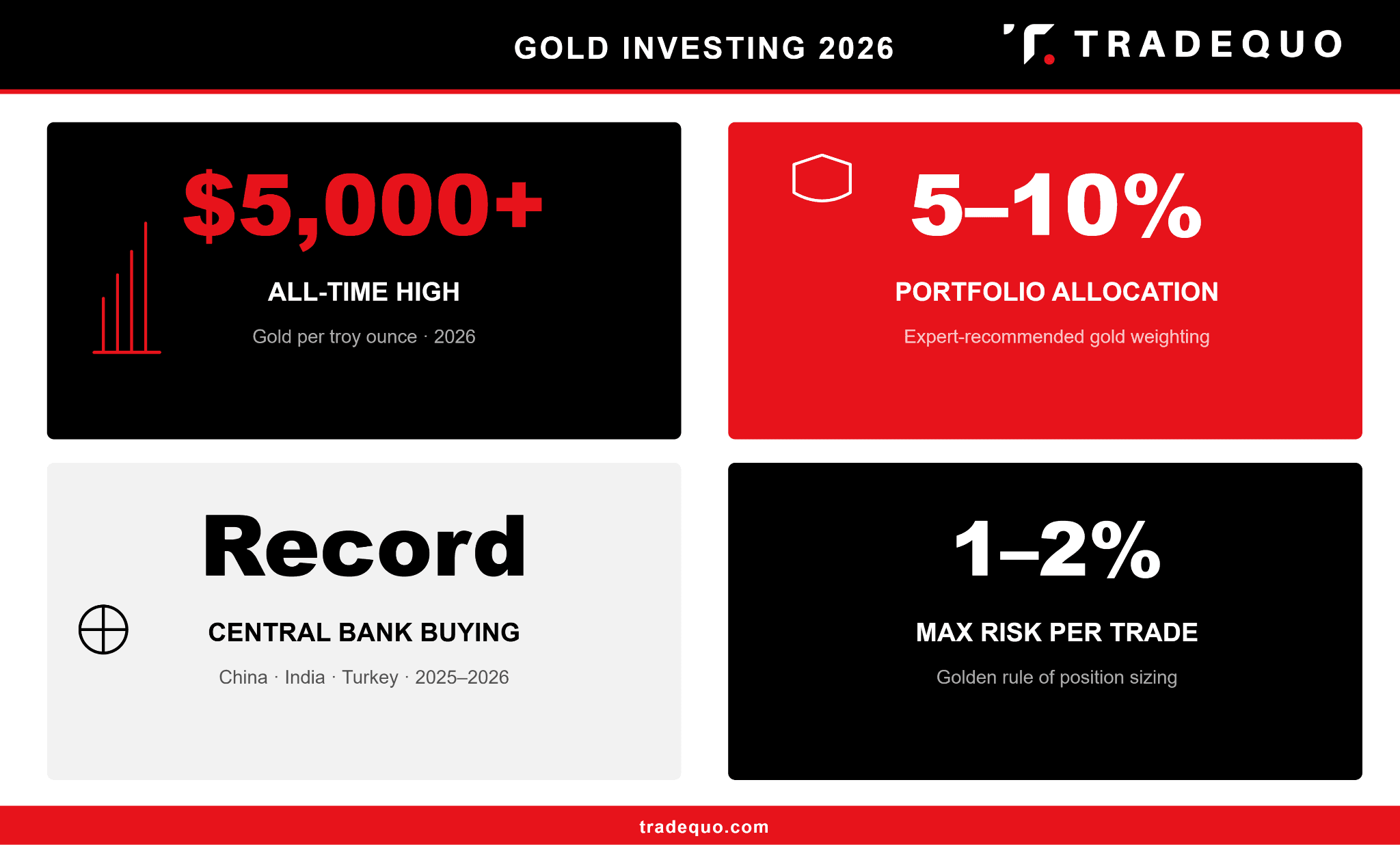
Gold has always held a certain mystique, hasn’t it? There’s something about holding a piece of history, a tangible asset that has represented wealth for thousands of years. And in 2026, that story took a new turn. Earlier this year, gold blew past the $5,000-per-ounce mark for the first time in history - a milestone that grabbed headlines and pulled a fresh wave of investors into the market.
The global economy has seen its fair share of shifts recently. From fluctuating interest rates to geopolitical tensions that keep the markets on edge, gold remains the "safe haven" asset that investors flock to.
Let’s explore everything you need to know: what gold trading actually is, the different ways to gain exposure, what moves the gold price, how to place your first trade, and the strategies and risk management principles that separate disciplined traders from impulsive ones.
Gold Trading vs Gold Investing
Buying (owning) gold and trading gold are not the same thing, even if they both involve exposure to its price.
Buying gold, in the traditional sense, means acquiring and holding it, often through direct purchase of physical gold such as bars or coins, or through financial instruments like ETFs. Purchasing physical gold provides direct exposure to gold's price movements, giving investors an immediate and tangible connection to the market. The goal is typically long-term wealth preservation. You’re not trying to time every move in the gold market. You’re simply holding an asset that tends to retain its value over time.
Trading gold, on the other hand, means actively speculating on short-term price movements. Traders use instruments like CFDs or gold futures contracts to profit from both rising and falling prices. This approach requires more technical knowledge, a clear strategy, and disciplined risk management.
In practice, many investors do both. They hold gold as a long-term position while also making shorter-term trades when market conditions present clear opportunities. Understanding which category you fall into, or what combination works for you, is the starting point for any sensible gold investment strategy.
The most commonly traded gold instrument in the forex and CFD world is XAUUSD, which represents the price of one troy ounce of gold measured in US dollars. If you’ve ever seen that ticker on a trading platform, that’s gold.
Why Invest in Gold in 2026?
You might be asking, “Is gold a good investment now?” Historically, gold has no dividend or yield. So why does Wall Street love it?
First, gold is the ultimate safe-haven asset. When the stock market gets edgy or geopolitical tensions rise (as we are seeing globally), investors flee to safety. Gold tends to hold its value or even rally when other markets are crashing. It has no credit risk; it is a valuable asset that does not rely on any government or corporation to fulfill a promise.
Second, it is a powerful hedge against inflation. Unlike paper currency, which central banks can print endlessly (devaluing your savings), gold is scarce. Because the global supply of gold is finite and grows slowly through mining, its value tends to rise when fiat currencies weaken. This inverse relationship makes gold a reliable inflation hedge over the long term. Even central banks around the world are massive holders of gold bullion bars, using it to back their reserves and protect against market price fluctuations.
Third, it offers portfolio diversification. Because gold often moves inversely to the US dollar and has a low correlation to equities, adding gold investments to your portfolio can complement other investments such as stocks and bonds, especially during periods of volatility in bond markets. Gold investments can help manage risk and provide stability when traditional assets experience market stress. Experts generally suggest allocating 5% to 10% of a total investment portfolio to gold.
Finally, it offers multiple entry points. Unlike some alternative assets, gold is accessible to virtually any investor, regardless of budget or experience. You can buy a fractional share of a gold ETF for a few dollars, or open a trading account and start with a modest deposit.
Furthermore, Gold also serves as a tangible asset. Unlike stocks or digital assets, physical gold has intrinsic value. For many investors, that psychological security matters just as much as the financial return.
Different Ways to Buy Gold
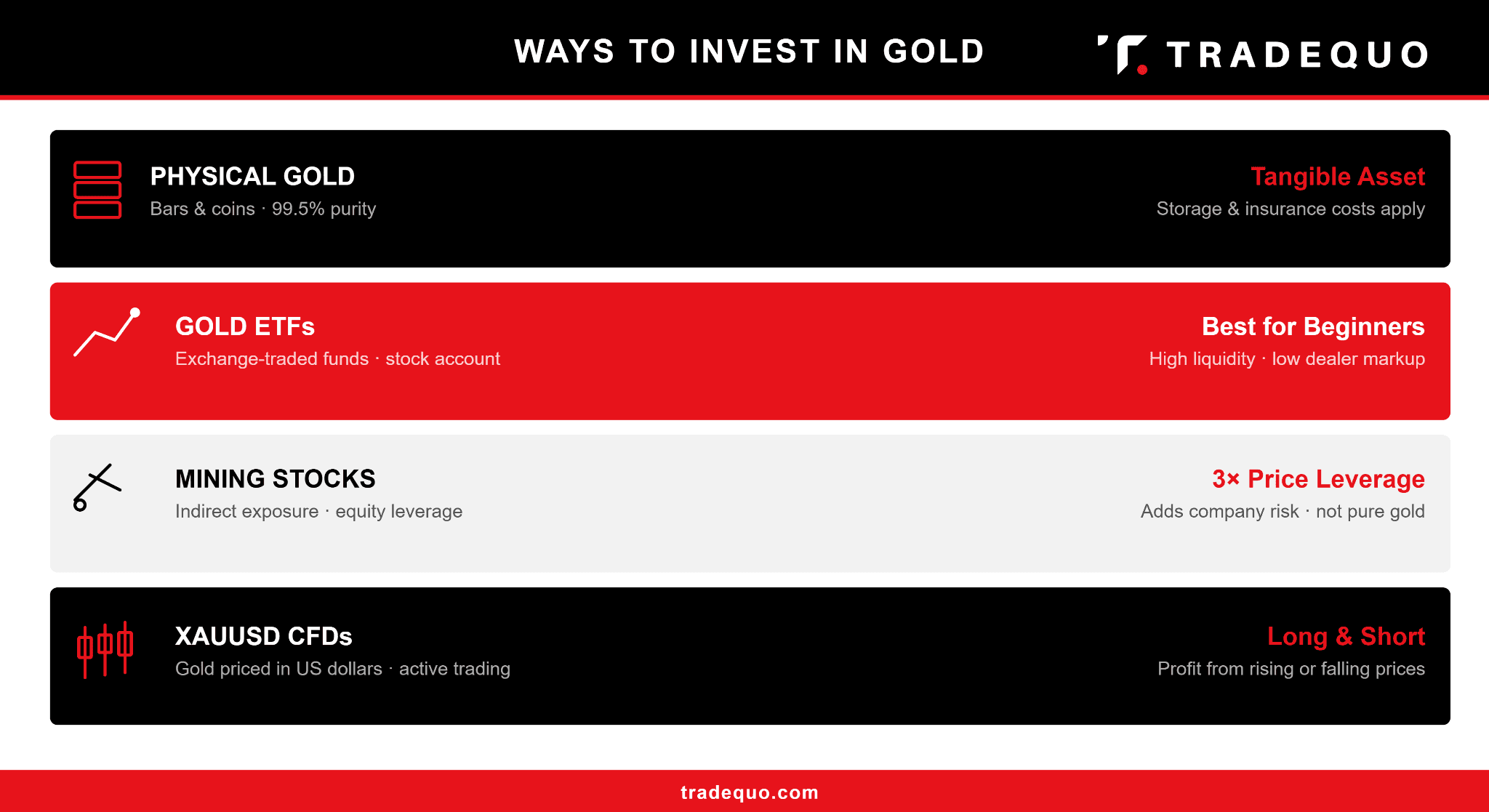
There's no single right way to invest in gold. The best method depends on your investment objectives, risk tolerance, and how directly you want to be exposed to the metal's price.
Buy Physical Gold: Bars and Coins
Purchase physical gold if you want the ultimate peace of mind.
Gold bullion refers to high-purity gold (usually 99.5% or higher) in the form of gold bars or gold coins. Gold bars come in various sizes, from small one-gram bars to larger 400-troy-ounce institutional bars. Gold coins are often issued by sovereign governments and tend to carry a premium of roughly 1% to 5% above their underlying gold value, reflecting minting and distribution costs. Sovereign coins like the American Gold Eagle or Canadian Maple Leaf are popular because they are easy to trade and government-backed.
However, there are downsides. You have to pay dealer premiums (markups over the spot price), storage costs (safes or bank deposit boxes), and insurance costs. When you sell gold, the resale price is often slightly below the spot price due to gold dealer margins.
Gold ETFs and Mutual Funds
If you want the price exposure without the hassle of storing heavy metal, exchange-traded funds (ETFs) are a popular investment option. These funds hold physical gold in secure vaults, and you simply buy shares of the fund. Gold ETFs trade just like stocks in a standard brokerage account, offering high liquidity and low costs compared to dealer premiums, and removing the worry of theft.
For most beginners looking to invest in gold for the first time, ETFs are the smartest entry point.
Gold Mining Stocks
This is an indirect exposure. Instead of owning the metal, you own shares in companies that dig it out of the ground. Major gold mining companies listed on international exchanges offer indirect gold exposure and operational leverage. If the gold price goes up 10%, a mining company’s profits might go up 30% (or down 30% if costs rise).
However, this adds "company risk." A mine could flood, labor could strike, or management could make bad decisions. It is a stock market play on gold, not pure gold ownership. For investors comfortable with equity analysis, gold stocks can add a layer of potential upside. For pure gold price exposure, ETFs or CFDs are usually more direct.
Accessing Gold in Your Region
Gold is a universal asset, but how people actually buy and trade it depends a lot on where they live, and in many markets, digital access has made the whole process faster and more straightforward than ever.
In the UAE, Dubai's gold market is one of the most active anywhere in the world. While physical gold still has its place, retail investors increasingly prefer trading through SCA-licensed brokers. No storage, no dealer markups, just direct exposure to live gold prices.
In Indonesia, physical emas (gold) purchases remain deeply familiar to local buyers, but XAUUSD trading is quickly gaining ground among younger retail investors who want lower entry costs and more flexibility.
In Thailand, gold is genuinely woven into everyday life. It's gifted at weddings, held as generational savings, and tracked closely by ordinary people, not just traders. TradeQuo supports Thai baht-denominated (THB) accounts, so local investors can participate without the friction of currency conversion.
In Colombia and across Latin America, gold is a trusted anchor in markets where local currency volatility can quietly erode savings. It consistently ranks among the most sought-after asset classes in the region.
For traders in all of these markets, the most flexible and cost-efficient way to access gold is through XAUUSD CFD trading with a regulated broker, which is exactly what we'll cover next.
Trading Gold with CFDs: The XAUUSD Market
For active traders, CFDs (Contracts for Difference) on XAUUSD (ticker symbol representing gold priced in US Dollars) represent the most direct and flexible way to trade gold price movements. When you trade XAUUSD via a platform like TradeQuo, you are trading a CFD.
You do not own the physical metal. Instead, you are speculating on the price movement. The massive advantage here is leverage. You can control a large position with a small amount of capital, and crucially, you can sell gold (go short) if you think prices are falling.
This approach suits traders who want to capitalize on short-term price movements and are comfortable with the mechanics of margin trading. It is, however, a high-risk instrument. The use of leverage amplifies both potential gains and potential losses.
How to Trade Gold: A Step-by-Step Guide
Now let’s get practical. If your goal is to actively trade gold, here is a simple process you can follow.
Step 1: Choose a Trading Platform
Your broker is the foundation of your trading experience. You want a platform that offers competitive spreads on gold, reliable execution, access to charting tools, and a clear fee structure. This is where TradeQuo stands out.
TradeQuo is a true no-markup broker that offers access to over 350 markets from a single account, including gold via XAUUSD. The platform supports MetaTrader 4 and MetaTrader 5, two of the most powerful and widely used trading platforms in the world.
TradeQuo also offers ultra-low spreads, including zero spreads on gold, which translates directly into lower trading costs for every position you open. With no minimum deposit required, it's a genuinely accessible starting point for traders at any experience level.
Furthermore, TradeQuo supports instant withdrawals 24 hours a day, seven days a week, and client funds are held in segregated accounts with global banks, giving you an added layer of security and confidence.
Step 2: Open and Fund Your Account
Once you've chosen a broker, the account opening process is typically straightforward. You'll provide identification documents to satisfy regulatory requirements, then deposit funds using your preferred method.
Step 3: Find XAUUSD on the Platform
On MetaTrader 4 or 5, gold is listed as XAUUSD. Navigate to the market watch panel, search for XAUUSD, and add it to your watchlist. From there, you can open a chart, apply your preferred indicators, and monitor price action in real time.
Step 4: Analyze the Market
Before placing any trade, you need a reason to be in the market. That reason should come from analysis, not instinct. Technical analysis involves studying price charts, support and resistance levels, trend lines, and indicators like RSI, MACD, and moving averages. Fundamental analysis means tracking the economic drivers that move gold, including inflation data, interest rate decisions, US dollar strength, and geopolitical developments.
Most successful gold traders use a combination of both. A technical setup that aligns with a fundamental catalyst tends to produce the strongest trade opportunities.
Step 5: Place Your Trade
Once you've identified a trade setup, open your order ticket. Specify whether you're buying (going long) or selling (going short), choose your lot size, and set your stop-loss and take-profit levels before executing. Never enter a trade without having your exit plan defined in advance.
Step 6: Manage Your Risk
Do not skip this. Before you hit "confirm," set your Stop Loss. This is an automatic "get me out" price if the trade moves against you. Without it, leverage can destroy your account on a bad day.
Ready to go deeper on strategy? Our 2026 gold trading guide covers the best strategies, current price forecasts from Goldman Sachs and UBS, and what makes this year's gold market unlike any other.
What Moves Gold Prices?
Understanding the "why" behind price movements is crucial for anyone learning how to trade gold XAUUSD. Gold does not exist in a vacuum; it is part of a complex global web.
The US Dollar: Gold is priced in dollars globally. Usually, when the dollar is strong, gold becomes more expensive for holders of other currencies, which can drive the price down. Conversely, a weak dollar often sends gold higher.
Inflation-Adjusted Bond Yields: Historically, when real interest rates (interest rates minus inflation) are low or negative, gold shines. Since gold pays no dividend or interest, it is more attractive when bonds aren't offering much of a return. In 2026, we have a unique situation: the Fed is holding rates high, but inflation is sticky. This creates volatility. Generally, if you believe inflation will stay high, gold goes up.
Geopolitical Stability: Gold is the ultimate "fear trade." When there is conflict or economic uncertainty, investors flee to the stability of precious metals. The current global landscape continues to push investors toward precious metals as a store of value.
Central Bank Demand: Large-scale buying by central banks can create a floor for prices, especially during periods of currency devaluation. In 2025 and 2026, central banks (especially in emerging markets) have been buying gold at record paces. This creates a solid floor of demand that didn't exist a decade ago.
Supply and demand dynamics: Mining output, recycling rates, and gold jewelry demand, particularly from major consuming countries, all factor into gold's price equation.
Best Gold Trading Strategies for 2026
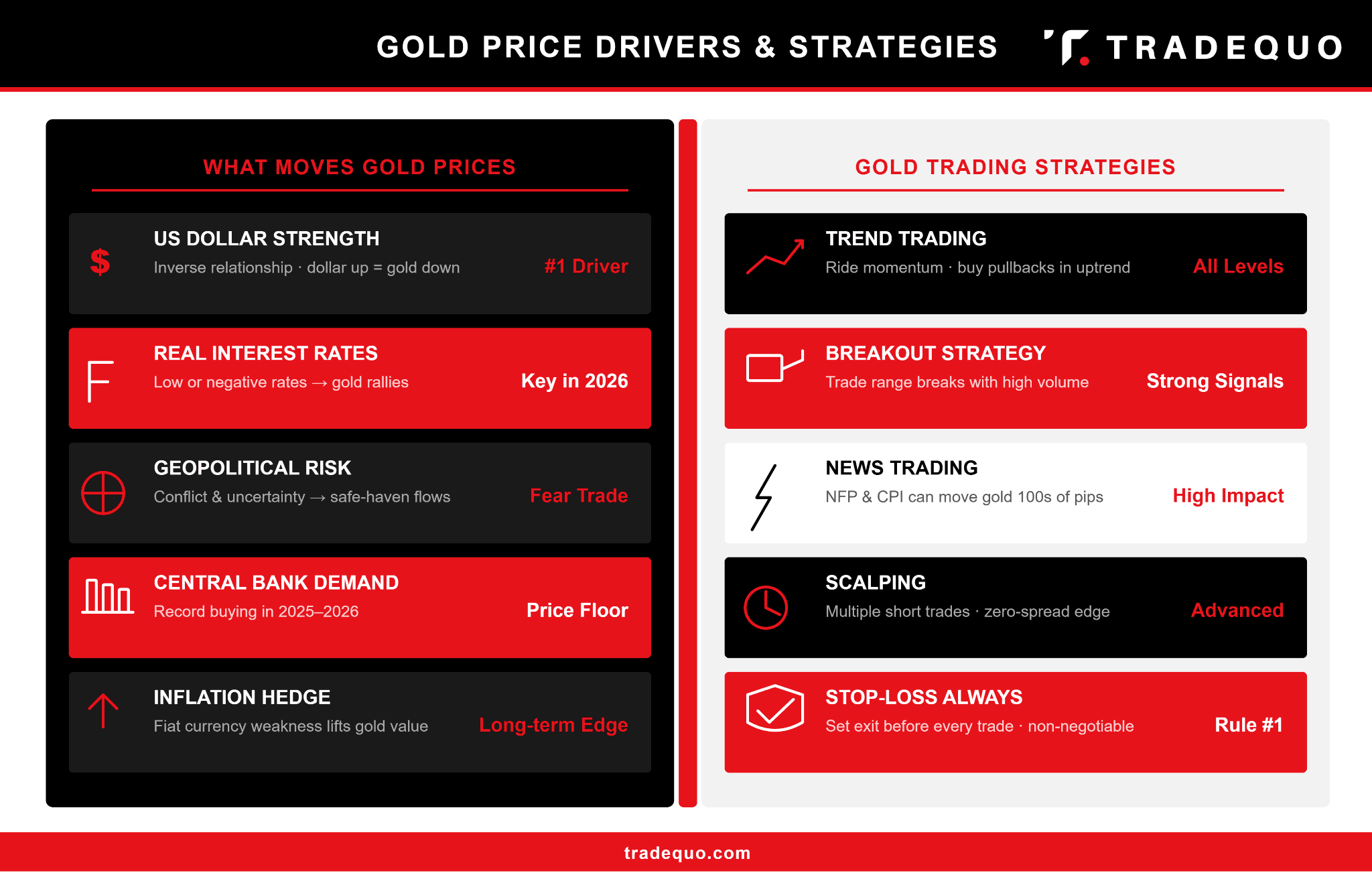
To succeed, you need more than just a feeling; you need a strategy. Here are a few that have stood the test of time:
Trend Trading
This is perhaps the most straightforward gold trading strategy. It involves identifying the overall direction of the market, either up or down, and entering positions that align with that momentum. If gold spot prices are consistently making higher highs, look for buying opportunities on pullbacks.
Breakout Strategy
Gold often spends long periods consolidating in a tight range. A breakout strategy involves waiting for the price to "break out" of this range with high volume. This often signals the start of a significant move, providing a clear entry point for traders.
News Trading
Because gold is so sensitive to economic data, many traders focus on "the news." Significant reports like the Non-Farm Payrolls (NFP) or Consumer Price Index (CPI) can cause the price of gold to move hundreds of pips in minutes. This requires quick reflexes and a solid understanding of market volatility.
Scalping
Scalpers make multiple short-duration trades throughout the trading session, targeting small price movements on each. This approach requires low spreads, fast execution, and intense focus. It's not typically recommended for beginners, but on a platform like TradeQuo, where gold spreads can reach zero, the cost-efficiency makes it considerably more viable.
Risk Management in Gold Trading
Gold can be a highly rewarding market, but it can also be extremely volatile. Price movements of 1% to 2% in a single session are not unusual, and during major news events, swings can be significantly larger. Without proper risk management, even a well-reasoned trade can result in substantial losses.
The 1-2% rule: Keep your risk on any single trade to no more than 1% to 2% of your total trading capital. This ensures that even a string of losses won't wipe out your account, and it keeps you in the business long enough for your edge to play out statistically.
Stop-loss orders are non-negotiable: Every trade you open should have a stop-loss set before execution. A stop-loss automatically closes your position if the price moves against you by a defined amount. It's your safety net. Traders who skip stop-losses tend to find themselves holding onto losing positions far longer than they should, hoping for a reversal that may never come.
Be cautious with leverage: Leverage amplifies both gains and losses. While it can make a modest account feel more powerful in terms of position size, it also dramatically increases the risk of significant loss. Beginners should use leverage conservatively until they have a thorough understanding of how it affects their risk exposure.
Volatility awareness: Gold trading hours matter. The most liquid and volatile periods for XAUUSD tend to coincide with the overlap of the London and New York trading sessions. During major news events, spreads can widen, and slippage can occur, factors that matter especially to traders using tight stop-losses.
TradeQuo's ZERO account is designed to reduce trading costs on gold, which matters most for traders using tighter stops.
Common Mistakes to Avoid
Even experienced traders make errors. Recognizing these patterns early can save you a great deal of frustration and capital.
Overleveraging
Using maximum leverage on early trades is one of the fastest ways to blow a trading account. High leverage feels exciting when trades go your way, but it's devastating when they don't. Start small and scale up as your confidence and consistency improve.
Trading without a plan
Walking into the market without a defined entry criteria, stop-loss level, and profit target is not trading. Every trade should have a logical basis, whether technical, fundamental, or both, before you commit capital.
Ignoring volatility
Gold can move sharply and suddenly. If you're not accounting for its typical daily range when setting stop-losses and position sizes, you're setting yourself up for premature exits and frustrating results. Know what you're dealing with before you trade it.
Emotional trading
Chasing losses after a bad day, sizing up impulsively after a winning streak, or deviating from your strategy because of a feeling rather than a signal, these are the habits that separate consistently losing traders from consistently profitable ones. Discipline matters more than intelligence in trading.
Is Gold a Good Investment in 2026?
The short answer is yes, but with nuance. If you are looking for a quick return, trading requires skill. If you are looking for wealth protection, buying gold now makes sense.
The structural case for gold remains intact: central bank demand is sustained, inflation has not been fully resolved, and geopolitical uncertainty continues to support safe-haven flows.
Begin with small positions, learn how the market behaves, and focus on managing risk. Platforms like TradeQuo make it easier to access gold trading through XAUUSD, even with limited capital.
Keep in mind, the key is consistency. Gold rewards patience, discipline, and a clear strategy.
FAQs
What moves gold prices up and down?
Gold prices are primarily driven by the US dollar (inverse relationship), real interest rates (lower rates push gold higher), central bank buying, inflation expectations, and geopolitical risk. In 2026, central bank demand from China, India, and Turkey has become a structural support floor that did not exist a decade ago.
Is gold trading risky for beginners?
Yes, gold can move $100 or more in a single session, especially during Fed announcements, CPI releases, or geopolitical events. The risk is real but manageable. Starting with a demo account, using micro lots (0.01), and always setting a stop-loss before entering a trade reduces the risk significantly.
What is the best time of day to trade gold?
The London–New York overlap (1:00 PM to 4:00 PM GMT) is the most active and liquid window for XAUUSD. Spreads are tightest, volumes are highest, and major US economic data that moves gold prices is released during this period. The Asian session is slower and better suited to range strategies.
What lot size should a beginner use for XAUUSD?
Start with 0.01 lots (a micro lot). At 0.01 lots on XAUUSD, each pip is worth approximately $0.10, which keeps losses small while you learn how the market behaves. Only increase your lot size after you have a consistent strategy and at least 20 completed trades in a demo or live account.
What spread should I expect when trading gold CFDs?
On TradeQuo's ZERO account, gold spreads can reach 0 pips during active market hours. Standard accounts carry a small spread built into the price. Always check the live spread before entering a position - spreads can widen during off-hours and major news events like NFP or FOMC announcements.