
Table of Contents
Why Gold Trading Is Booming in 2026
What Is Gold Trading and How Does It Work?
Gold Price Forecast for 2026
How to Trade Gold: Step-by-Step Guide
Best Gold Trading Strategies in 2026
Risks of Trading Gold
What Lot Size Should a Beginner Use for XAUUSD?
Best Time to Trade Gold
Why TradeQuo for Gold Trading?
Is Gold Still Worth Trading in 2026?
Frequently Asked Questions
Gold is everywhere again. Not in a nostalgic “remember when gold mattered” way, but in a very real, very immediate “what just happened to the markets” kind of way. After years of playing second fiddle to crypto and growth stocks, the oldest monetary asset on earth is having a moment. Actually, it’s having more than a moment.
Gold trading in 2026 looks nothing like it did even two years ago. Daily price swings exceeding $100 have become routine. The metal shattered the 5,000-per-ounce barrier. Central banks are buying gold at a pace that analysts call a “structural necessity” rather than a tactical move. And perhaps most interestingly, gold isn’t always behaving like gold anymore. It’s acting differently, and that’s exactly why you need to understand how to trade it right now.
Whether you’re completely new to this or you’ve traded gold for years, the 2026 market demands a fresh approach. Let’s walk through what’s actually happening, why it matters, and how you can think about trading gold in this environment without getting swept up in the hype or flattened by the market volatility.
Why Gold Trading Is Booming in 2026
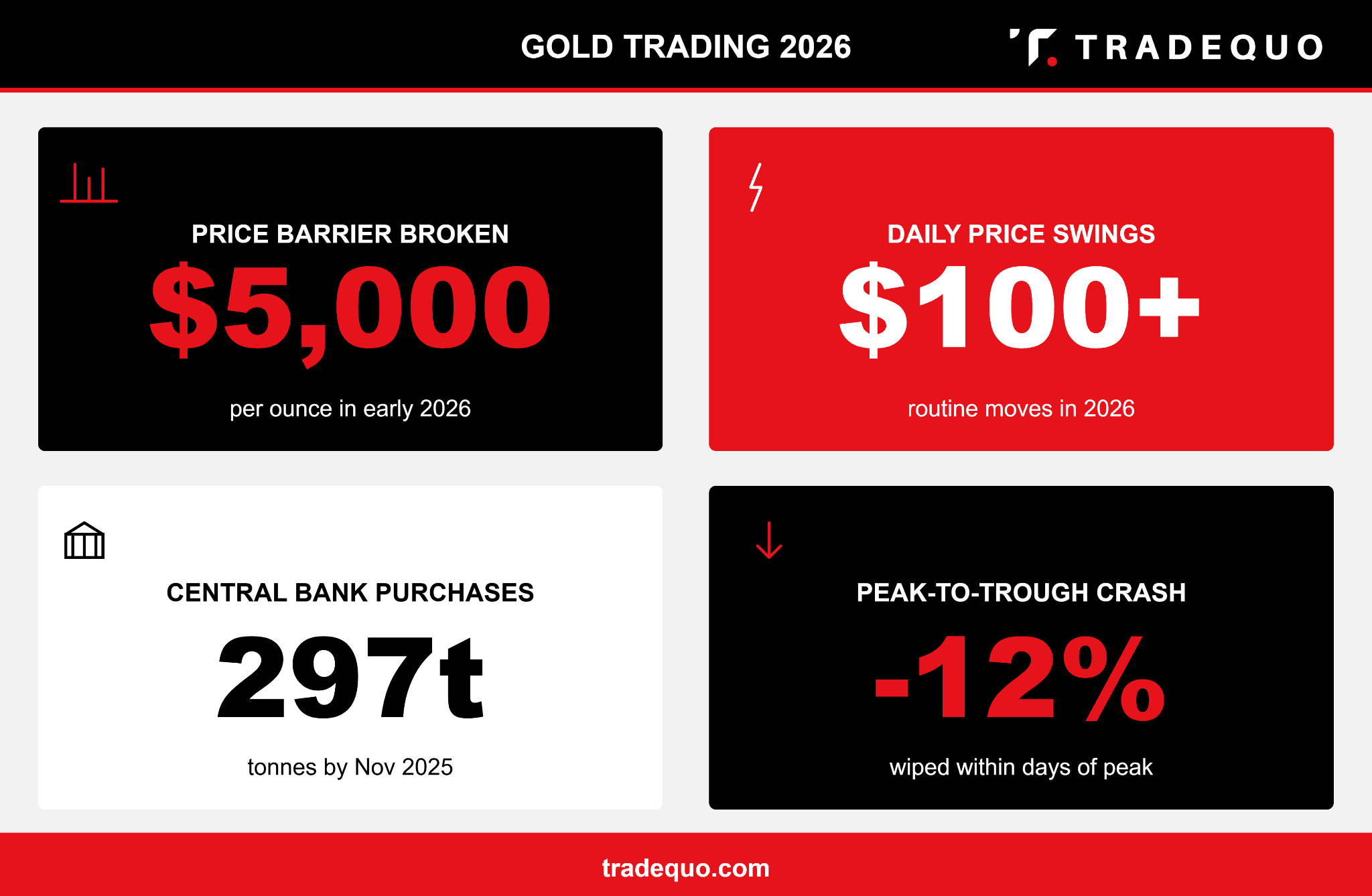
Let’s start with the numbers that explain everything. In the first few weeks of 2026 alone, gold gained over 1,000 dollars. That’s not a typo. XAUUSD climbed above 5,000 and kept going, with daily ranges that would have seemed impossible just a few years ago. For context, gold’s daily moves in 2026 regularly hit 3 to 4 percent, which is enormous for an asset known for its relative stability. Though that gain was followed almost immediately by one of the sharpest single-day collapses in decades, wiping out more than 12% from the peak within days.
What’s driving this? Three things, really, and they’re all happening at once.
First, inflation and interest rates are creating the perfect backdrop for gold. The relationship is simple: when real yields decline, the opportunity cost of holding gold falls, and prices tend to rise. We’re seeing that play out in real time. But let’s discuss the twist that makes 2026 different. Historically, gold would sell off when yields ticked up. That’s not happening the way it used to, and that brings us to the second factor.
Central banks have fundamentally changed the demand structure for gold. According to the World Gold Council, central bank purchases hit 297 tonnes by November 2025, marking one of the strongest demand periods in the dataset’s history. Countries including China, India, Turkey, and Poland are systematically diversifying away from dollar-denominated assets, and they’re doing it regardless of price.
Then there’s the geopolitical layer. The Middle East conflict has added sustained upside pressure to gold prices and volatility. Unlike previous conflicts where gold spiked and then faded, this environment feels different because it’s layered on top of that structural central bank demand. The old playbook, where gold rallies sharply on a crisis then retreats as soon as tensions ease, doesn’t fully apply anymore. We saw that in 2022 with the Russia-Ukraine invasion, and we’re seeing it again now, but amplified by the new demand dynamics.
HSBC made an observation in early 2026 that captures the complexity of the moment. Gold has started behaving more like a risk asset in certain conditions. That’s a striking comment for a precious metal that’s been called a safe haven for centuries. What they mean is that retail and leveraged flows are driving a lot of the action, which creates more volatility and less predictable correlations than institutional investors historically expected.
What Is Gold Trading and How Does It Work?
Before we go further, let’s get clear on what we’re actually talking about. Gold trading means speculating on the price movements of gold rather than owning physical metal. You’re not buying gold coins or bars. You’re placing trades based on where you think the price will go, and you can profit whether it goes up or down.
On online trading platforms, gold is represented by the symbol XAUUSD. XAU is the chemical symbol for gold, USD is the US dollar, and the pair represents the price of one troy ounce of gold in dollars. When you trade XAUUSD, you’re trading the spot price, meaning the current market price for immediate settlement.
There are several ways to get exposure:
Spot trading is the most direct, where you’re essentially speculating on the current price.
Gold futures contracts let you agree on a price today for delivery on a specific future date.
Options give you the right but not the obligation to buy or sell at a predetermined price.
And then there are CFDs, or contracts for difference, which are particularly popular for online gold trading because they allow you to speculate on price movements without owning the underlying asset.
Here’s a simple example. Let’s say gold is trading at 5,200 per ounce. You believe prices will rise because the Fed has signaled rate cuts. You buy one CFD contract at 5,200. Two weeks later, gold hits 5,400. You close your position and capture the 200-point move. The same logic works in reverse. If you think gold prices will fall, you can sell first and buy back later at a lower price.
One thing to understand about CFD trading is that you don’t own the physical asset. That means you don’t get the long-term value retention benefits of holding actual gold bars. What you do get is leverage, which we’ll talk about in the risk section, and the ability to trade in both directions with relatively small amounts of capital.
Gold Price Forecast For 2026
Forecasting the price of gold is never exact, but current market conditions offer a few realistic scenarios, and some of the early 2026 calls have already been tested hard by the market.
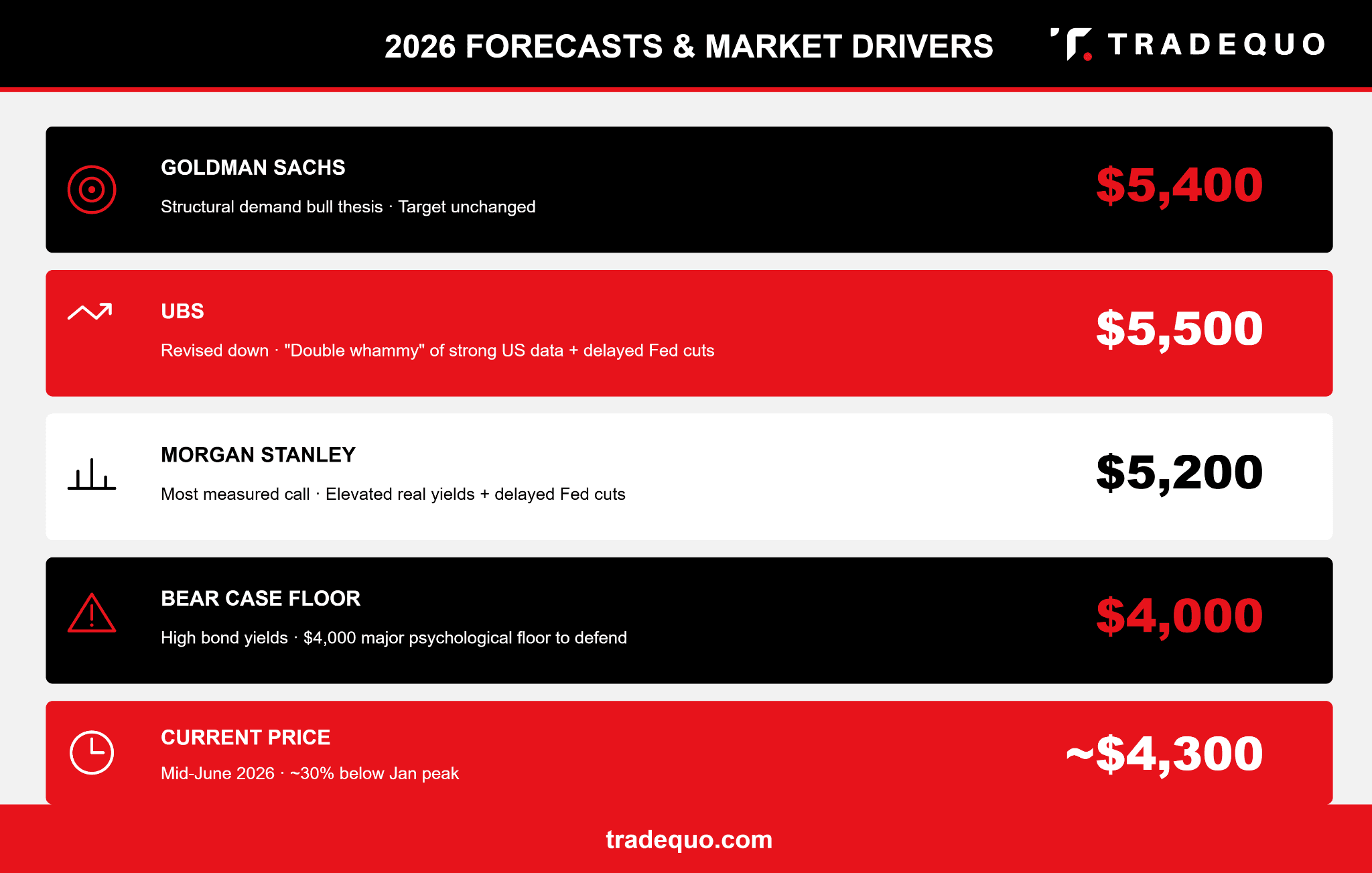
When UBS raised its target to $6,200 per ounce for the first three quarters of 2026 back in January, gold was running hot, and the bank was projecting continued strong central bank buying, higher ETF inflows, and more bar and coin purchases, driven by lower US real rates and ongoing global economic uncertainty. That target is now significantly off track. UBS has since cut its year-end 2026 forecast from $5,900 to $5,500 per ounce, citing what its strategists described as a "double whammy" of stronger US economic data and a Fed easing timeline that has been pushed back to 2027. UBS analysts noted that markets are "rediscovering the concept of opportunity cost," with gold's non-yielding characteristics becoming a more important consideration as real rates remain elevated, and that both ETF and futures demand have softened significantly.
As of mid-June 2026, gold is trading near $4,300 per ounce, roughly 30% below UBS's year-end target. The gap between January's euphoria and today's reality is a useful reminder of how quickly structural narratives can meet macro headwinds.
Goldman Sachs has held its ground with more discipline. Analysts raised the target from $4,900 to $5,400 in January 2026 and haven't moved off it since, even as March's sharp decline tested conviction. In June 2026, Goldman stripped all remaining 2026 rate cuts from its forecast, shifting expected easing to 2027, yet left the $5,400 gold target intact - the clearest possible signal that their bull thesis rests on structural demand, not Fed policy.
UBS's longer-term argument still leans heavily on central bank demand, and on that front, the data shows no slowdown. The bank expects annual central bank gold buying to stay within the 750 to 1,000 metric ton range for 2026. Preliminary May figures show the People's Bank of China added 10 metric tons to its reserves, while Uzbekistan's central bank purchased nearly 9 metric tons in the same month.
Morgan Stanley revised its H2 target from $5,700 down to $5,200 by Q4 2026, citing elevated real yields and delayed Fed cuts, the most measured call among major banks, but still directionally bullish.
The bear case has sharpened since January. Persistently high bond yields reduce gold's relative attractiveness. Some analysts now expect gold to decline toward the $4,370 to $3,816 range by year-end amid ongoing geopolitical uncertainty and the possibility of further Fed rate moves. The $4,000 level has become the major psychological floor that bulls need to defend.
The honest summary heading into H2 2026: the structural case, central bank demand, inflation that hasn't fully been tamed, dollar uncertainty, remains intact. But the price already ran far ahead of it in January, and the market is still digesting that overshoot. Traders should treat both the Goldman $5,400 target and the bear case $4,000 floor as live scenarios, not background noise.
How to Trade Gold: Step-by-Step Guide
You do not need years of experience to start trading gold online. You need a clear process, a platform you trust, and the discipline to manage risk before you think about returns.
Step 1: Choose a Broker
Not all brokers treat gold the same way. Look for transparent pricing, tight spreads on XAU/USD, a regulated operating environment, and a platform that works for your trading style. TradeQuo has become a compelling option for gold traders. It has built its gold trading proposition around zero spreads on XAU/USD, something that genuinely sets it apart in an industry where hidden trading costs are the norm. Combine that with access to MT4 and MT5, multilingual support, fast execution, and a no-minimum-deposit structure, and you have a platform designed for traders at every level who are serious about reducing friction and maximising their edge.
Step 2: Select Your Gold Instrument
For most retail traders, gold CFDs on XAU/USD are the most practical entry point. They offer leverage, two-directional trading, and real-time pricing without the complexity of futures contracts. If you prefer a lower-risk approach, gold ETFs (Exchange Traded Funds) give you directional exposure with less overnight risk.
Step 3: Analyse the Market
Combine both technical and fundamental analysis. On the technical side, look at the 50-day and 200-day moving averages to gauge trend direction, use the RSI to identify overbought or oversold conditions, and watch Fibonacci retracement levels for potential entry points during pullbacks. On the fundamental side, keep an eye on the Fed's meeting calendar, US inflation data releases, and any geopolitical developments that might trigger safe-haven flows.
Step 4: Place Your Trade
Define your entry price, set a stop-loss level to limit your downside, and identify a take-profit target before you open the position. Seasoned traders typically limit their risk to just 1%–2% of their account per trade, no matter how strong their conviction.
Step 5: Manage Risk Actively
Gold can move hundreds of dollars in a single session during major news events. Always use stop losses. If a trade moves against you, do not average down, hoping the market will reverse. Stick to your plan, accept the loss if it hits your stop, and preserve capital for the next opportunity.
Best Gold Trading Strategies in 2026
Success in the gold market requires a plan. Here are the most effective strategies being used by professionals this year.
Trend Trading
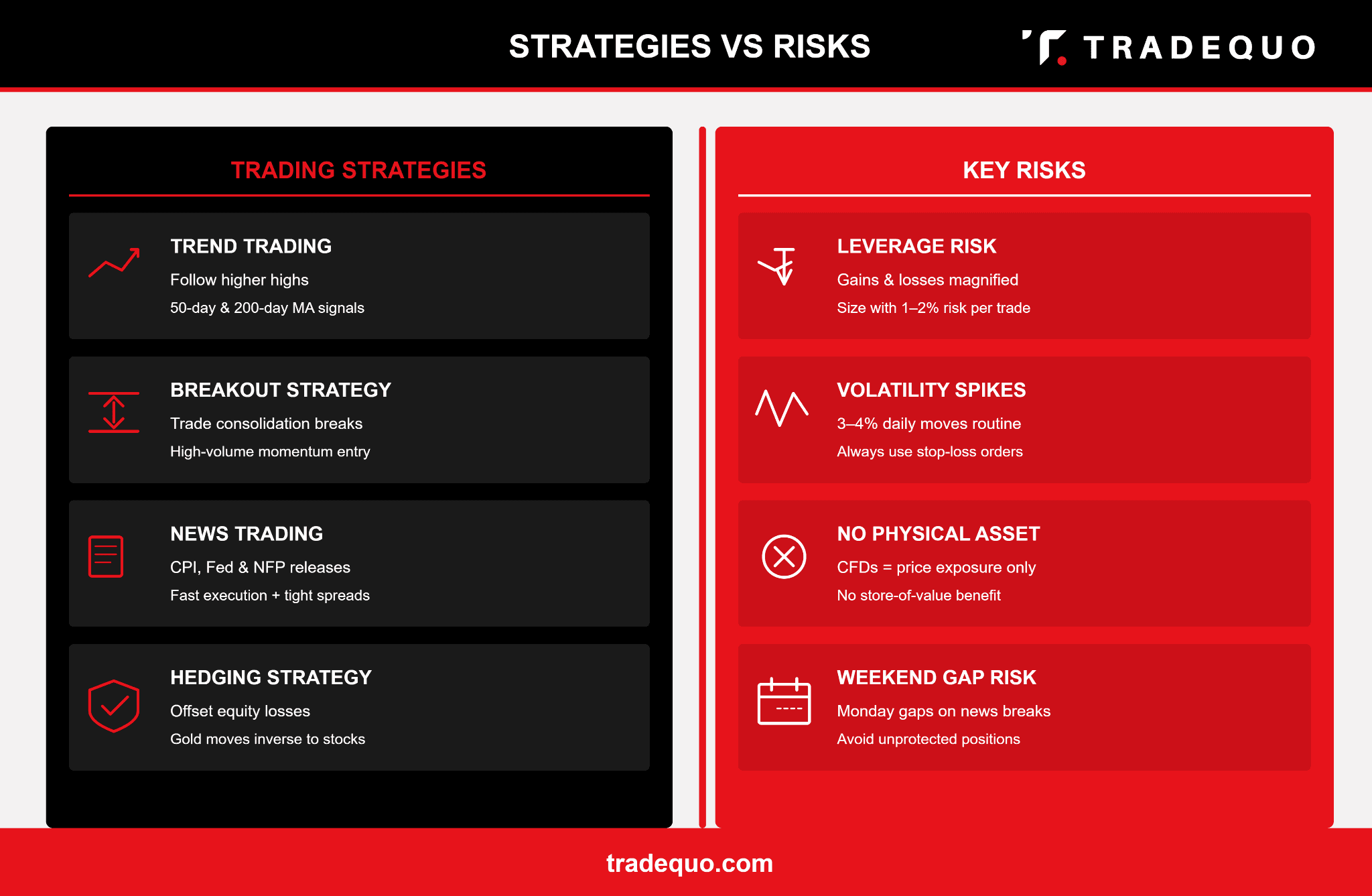
Trend trading is built on one simple idea: price moves in sustained directions, and following those directions is more reliable than fighting them. By using trendlines and moving averages, traders stay on the right side of the market moves. If the price is consistently making higher highs, the trend is up, and traders look for "buy the dip" opportunities.
Breakout Strategy
Gold often consolidates in a narrow range for weeks before exploding in one direction. A breakout strategy involves placing orders just above or below these consolidation zones. When the market moves, it often does so with high volume, allowing traders to catch the start of a new momentum wave.
News Trading
Because gold is sensitive to inflation data and Federal Reserve announcements, many traders focus exclusively on these events. This involves making trades based on the deviation between actual economic data and market expectations. This strategy requires fast execution, tight spreads, and iron discipline around stop-loss placement. TradeQuo's execution environment is well-suited to this approach, given its pricing model.
Hedging Strategy
Many investors use gold to hedge against losses in their equity portfolios. Since gold often moves inversely to stocks during a crash, holding a gold position can offset losses elsewhere, protecting the overall value of a diversified portfolio.
Risks of Trading Gold
Let’s be direct about the risks because too many articles gloss over them.
Gold can be highly volatile, particularly around central bank decisions and geopolitical events. The metal dropped more than 8% in a matter of days in early April 2026 as Middle East tensions partially eased and the dollar found some support. Traders who were not protected by stop losses felt that move acutely.
Leverage amplifies this risk significantly. Trading gold on margin means controlling a large position with a relatively small deposit. The upside is that gains are magnified. The downside is that so are losses, and a position can be liquidated before the market reverses in your favour if you have not sized your trade appropriately.
When trading gold CFDs, you do not own the underlying metal. This means you miss out on the long-term store-of-value characteristic that makes physical gold bars attractive to wealth preservation investors. CFDs are instruments for capturing price movements, not building tangible assets.
Finally, be wary of market manipulation concerns in commodity markets. They are real, though regulators have become more active in recent years. Trading through a properly regulated broker, using limit orders where possible, and avoiding illiquid trading hours all reduce your exposure to this risk.
What Lot Size Should a Beginner Use for XAUUSD?
Position sizing is where most new gold traders quietly destroy their accounts. Not through bad analysis, but through trading sizes that turn normal market noise into account-ending losses.
Start with a micro lot: 0.01. At that size, each pip move in XAUUSD is worth roughly $0.10. On a standard account with 1:100 leverage, opening a 0.01 lot position requires approximately $5 in margin. That's intentionally small, because gold in 2026 regularly moves 300 to 500 pips in a single session. At 0.01 lots, a 200-pip move against you costs $20, not $200. That gap is the difference between a learning experience and a blown account.
The rule is simple: don't scale up until you have at least 20 consecutive trades logged, reviewed, and understood. Not 20 winning trades. Twenty trades where you followed your plan, honored your stop-loss, and recorded the outcome.
From there, scale deliberately: 0.01 → 0.05 → 0.10, increasing only when your account size and win rate support it. TradeQuo's ZERO account is particularly well-suited to this approach, offering the tight conditions that make small-lot trading genuinely viable from day one.
Best Time to Trade Gold
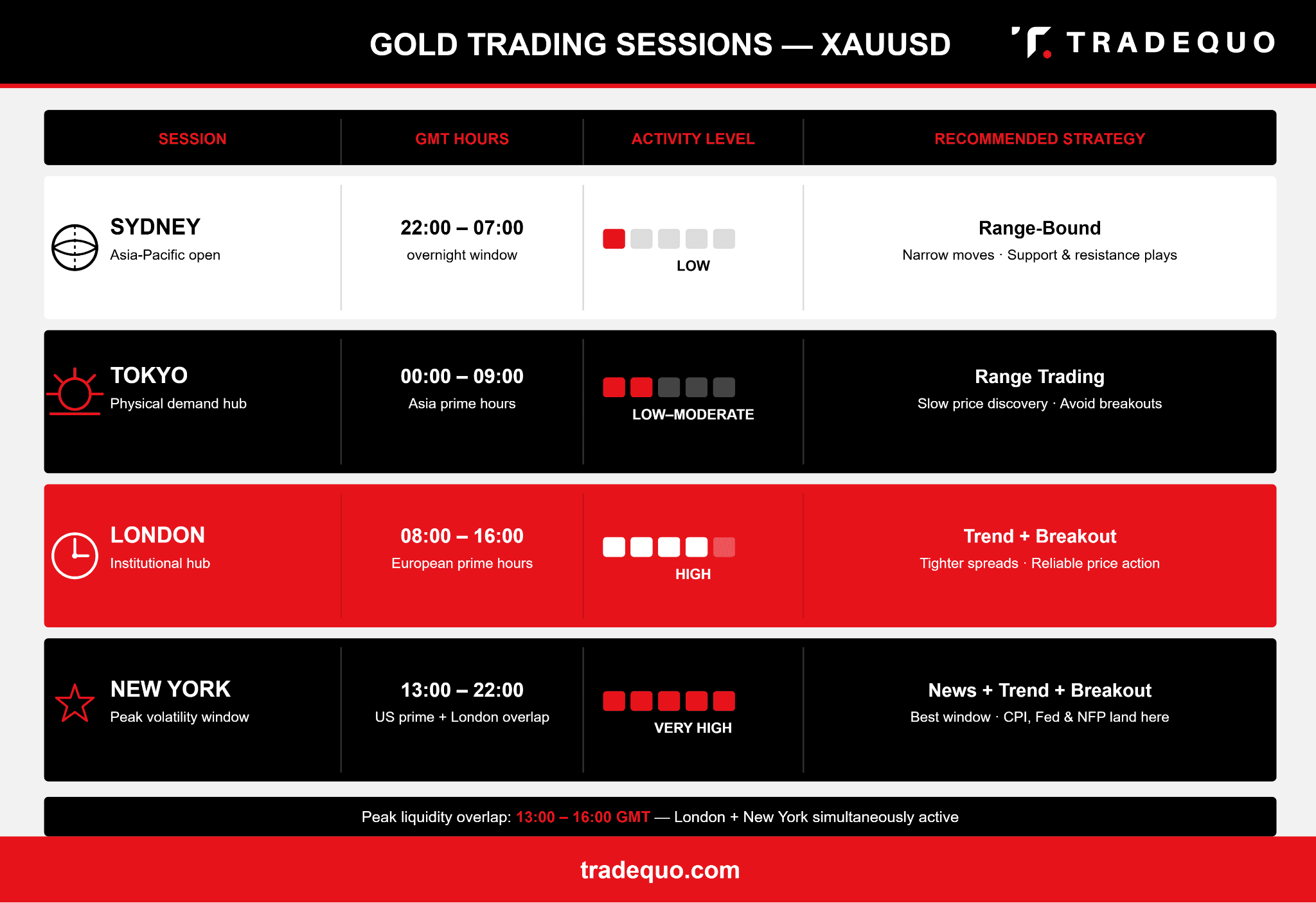
Gold markets are open 24 hours a day, five days a week, but not all hours are created equal.
The London session, running roughly from 8:00 AM to 4:00 PM GMT, is where institutional gold trading volumes pick up meaningfully. European banks, commodity desks, and funds all become active, creating tighter spreads and more reliable price action.
The most potent window is the New York and London overlap, typically 1:00 PM to 4:00 PM GMT. Both major financial centres are simultaneously active, liquidity is at its peak, and major US economic data releases land during this period. If you can only trade for a few hours a day, this is the time to be watching.
The Asian session, while active in terms of physical gold demand, particularly from China and India, tends to produce narrower ranges and slower price discovery in the futures and spot markets. It can be good for range-bound strategies but less reliable for breakout or trend approaches.
Avoid trading in the final hours before the weekend close unless you have a specific reason. Gold can gap on the open the following Monday if significant news breaks over the weekend, and holding positions without protection over that window is an avoidable risk.
Why TradeQuo for Gold Trading?
Platform choice matters more in gold trading than in almost any other market. When XAUUSD moves 400 pips in an hour, the difference between a broker with tight spreads and one without can be the difference between a profitable trade and a breakeven one.
Here's what TradeQuo specifically offers gold traders.
The ZERO account eliminates the spread on XAUUSD during active market hours. For a market where you're often entering and exiting multiple times per session, that removes a cost that compounds quickly across a trading month.
Liquidity is sourced through LMAX, an institutional-grade venue with no dealing desk intervention. That means the price you see is the price you get, without requotes or artificial slippage during volatile news events, exactly when execution quality matters most.
The platform runs on MetaTrader 5, which gives gold traders access to 21 timeframes, a full technical indicator suite, and native support for Expert Advisors if you run automated strategies.
For news traders specifically, the integrated Economic Calendar keeps Fed announcements, CPI releases, and NFP dates visible without leaving the platform. Gold reacts sharply to all three.
The $1 minimum deposit makes the account genuinely accessible at any starting point, and 24/7 instant withdrawals remove the friction that erodes trust with most retail brokers.
These are the functional reasons gold traders use this platform over alternatives.
Is Gold Still Worth Trading in 2026?
Gold in 2026 is not the sleepy safe-haven trade of a previous generation. It is an active, technically rich, fundamentally driven market that rewards preparation and punishes complacency. The underlying structural case remains compelling: central banks are still buying, inflation has not been fully tamed, geopolitical instability shows no signs of resolving cleanly, and the dollar faces long-term challenges that gold directly benefits from.
New to gold trading and want to start from the very beginning? Our beginner's guide walks you through every step - from choosing how to get exposure to placing your first XAUUSD trade.
Trade smart, manage your risk, and the yellow metal might just surprise you.
FAQs
What is the best time of day to trade gold?
The best window is the London–New York overlap, roughly 1:00 PM to 4:00 PM GMT. Both major financial centres are active simultaneously, liquidity is at its peak, and US economic data releases, which directly move gold, land during this period. Avoid the hour before the weekend close.
What lot size should a beginner use for XAUUSD?
Start with 0.01 lots (a micro lot). On XAUUSD, each pip at 0.01 lots is worth roughly $0.10. This keeps risk manageable while you learn how gold moves. Scale up to 0.05 or 0.10 lots only after 20+ consistent trades with a clear strategy.
What spread should I expect on gold CFDs?
Spreads vary by account type and market conditions. On TradeQuo's ZERO account, gold spreads start from 0 pips during active market hours (London and New York sessions). During off-hours or high-volatility events like NFP, spreads can widen temporarily. Always check live spreads before entering a position.
What are the biggest risks of trading gold?
Gold's main risks are leverage amplification, news-driven volatility (gold can move $100+ in one session), and the temptation to hold losing positions without a stop-loss. Central bank announcements, US CPI data, and geopolitical events can cause sharp, fast moves that catch underprepared traders off guard.
How do central banks affect gold prices?
Central banks are now the largest structural buyers of gold globally. When central banks buy at scale, as China, India, Turkey, and Poland have been doing, they create sustained demand that supports the price floor regardless of short-term market sentiment. The World Gold Council reported 297 tonnes of central bank purchases by November 2025.