
Table of Contents
What Makes a Day Trading Strategy Effective?
Momentum Trading
Breakout Trading
Scalping
Mean Reversion
Risk Management Across Day Trading Strategies
Conclusion
Frequently Asked Questions
What Makes a Day Trading Strategy Effective?
Day trading is one of the most demanding activities in the financial markets, and for good reason. The window of opportunity opens and closes in minutes, sometimes seconds, and every decision carries real financial weight. Yet for traders who invest the time to study their craft, day-trading strategies can provide a structured way to mitigate that pressure.
The key is understanding that no single approach works in every situation. The best strategy for you depends on your risk tolerance, available capital, and how you respond under stress. Some traders shine on fast momentum plays; others prefer the patience of waiting for a clean breakout.
Let's explore four proven approaches, along with the risk management practices that sustain them.
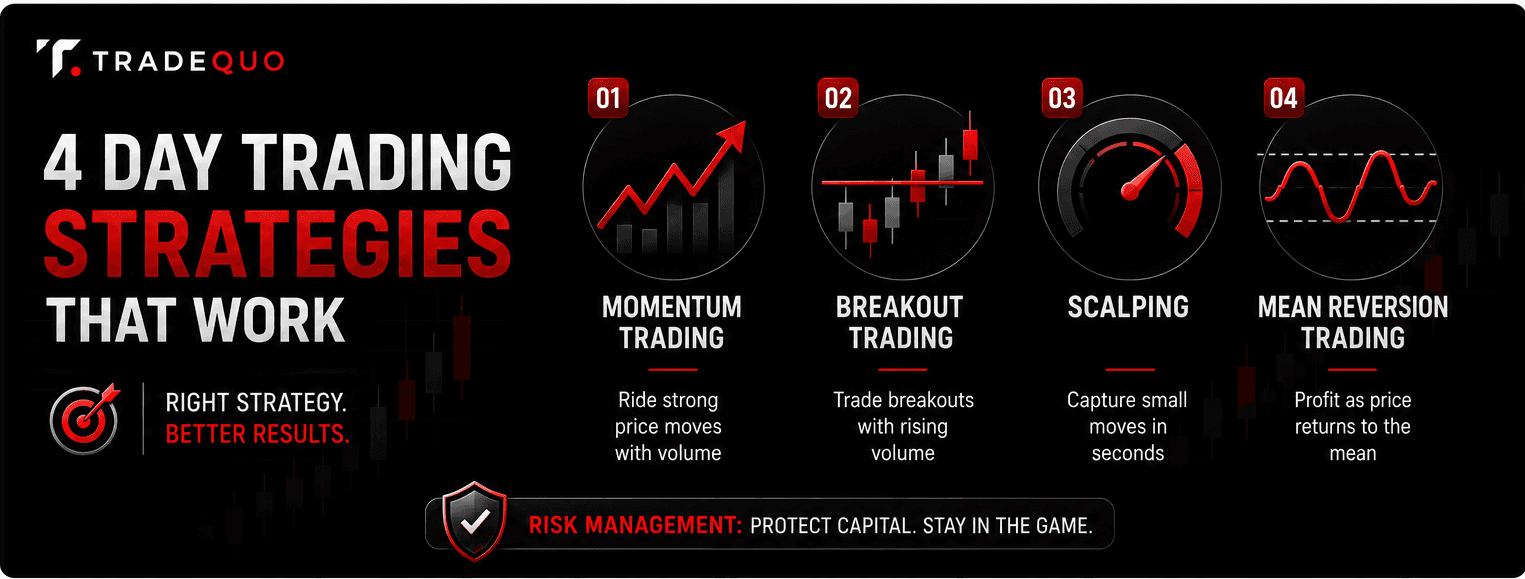
Momentum Trading
Momentum trading is one of the most widely used day trading strategies in the stock market. The idea behind this trading strategy is simple. When a financial asset begins moving strongly in one direction, traders attempt to ride that trend until momentum fades.
Momentum traders look for securities experiencing high trading volume and strong short-term price movements. These movements often occur after major news announcements, earnings reports, or changes in market sentiment. In such situations, traders believe the trend will continue long enough to capture quick profits.
A typical momentum trading strategy involves buying assets when prices are rising rapidly and selling them later in the same trading day. Conversely, traders may short-sell assets that are falling sharply. The goal is to take advantage of short-term price fluctuations before the trend slows.
Technical analysis plays a central role in momentum trading. Traders rely on price charts and technical indicators to identify strong trend direction and potential entry and exit points. Among the most commonly used tools are moving averages and the moving average convergence divergence indicator, which helps traders detect shifts in momentum.
Volume indicators are also critical. When price movement is supported by high volume, it signals strong participation from other traders and market makers. High trading volumes provide liquidity, allowing traders to enter and exit positions quickly without significant price slippage.
Momentum trading can generate significant profits during periods of strong volatility. However, it also carries substantial risk. Momentum can reverse suddenly, especially when traders rush to lock in profits.
For this reason, successful traders always define a profit target and place stop-loss orders to limit potential losses. Emotional discipline is also important. Many traders fail because they chase momentum too late, entering positions after the majority of the move has already occurred.
Breakout Trading
Breakout trading focuses on identifying key levels where price may begin a new trend. In financial markets, support and resistance levels often act as barriers where prices repeatedly reverse. When the price finally moves beyond these levels, traders interpret it as a signal that momentum may accelerate.
Breakout trading occurs when a trader enters a position after the price moves above a resistance level or drops below a support level, accompanied by rising trading volume that signals stronger market participation. These breakouts can signal the beginning of strong short-term price movements as more traders enter the market.
Experienced day traders often draw trend lines and analyze price patterns on price charts to identify potential breakout points. When the market approaches these levels, traders prepare to act quickly.
For example, if a stock trades within a tight range during the morning session and suddenly breaks above resistance with high volume, breakout traders may buy immediately. They expect that other active traders will also notice the breakout, pushing the price higher.
However, false breakouts are common in intraday trading. A price may briefly move above resistance only to reverse minutes later. This is why confirmation is essential. Traders often wait for additional signals such as sustained volume, strong candlestick patterns, or confirmation from technical indicators.
Breakout trading can be applied to many financial assets, including stocks, currencies, and other financial instruments. It works particularly well in markets experiencing increased volatility or major news events.
Successful breakout traders focus on precise entry and exit points. They often place stop-loss orders just below the breakout level to limit risk if the trade fails.
While the potential for significant profits exists, breakout trading still involves substantial risk. Without proper risk management, traders may experience rapid losses when false signals appear.
Scalping
Scalping represents one of the fastest forms of active trading. Unlike other day trading strategies that aim to capture larger price moves, scalping focuses on very small gains repeated many times throughout the trading day.
Scalpers attempt to profit from small, short-term price movements occurring within seconds or minutes. Instead of holding positions for hours, they may open and close dozens or even hundreds of trades in a single trading session.
This approach works best in highly liquid markets where high trading volumes allow quick execution. Day trading stocks with tight spreads are often preferred because even small price changes can generate profits when repeated frequently.
Speed is essential in scalping. Traders rely on fast trading platforms provided by their brokerage firm to execute trades instantly. Market conditions must also support quick movement and strong liquidity.
Scalpers frequently use price action trading techniques, analyzing very short-term price charts and micro price patterns. Technical indicators may include moving averages, the moving average convergence divergence oscillator, and other tools designed to highlight rapid momentum shifts.
Because profit targets are small, controlling costs becomes critical. Transaction fees, spreads, and slippage can quickly reduce profitability. This is why scalping is often practiced by experienced traders who understand the mechanics of intraday trading.
Another challenge is psychological pressure. Constant decision-making throughout the trading day can be mentally exhausting. Many traders struggle to maintain discipline after a series of losses.
Despite these challenges, scalping remains one of the most popular day trading strategies among active traders. When executed with precision and strong risk management, it can produce consistent small gains that accumulate over time.
Mean Reversion
Mean reversion is based on the idea that prices rarely move in a straight line forever. Instead, markets often swing above and below an average value. Mean reversion traders attempt to profit when prices move too far from that average.
In simple terms, the strategy assumes that extreme price moves eventually return toward their typical level. When an asset becomes overbought, traders may short-sell it. When it becomes oversold, they may buy, expecting a rebound.
Technical analysis plays a major role in identifying these conditions. Traders study price charts, trend lines, and technical indicators that highlight overbought or oversold levels.
For example, if a stock rises sharply during the morning session and moves far above its recent average price, mean reversion traders might expect the rally to slow. They may enter a short position anticipating a pullback later in the same trading day.
Mean reversion strategies often rely on high-probability setups rather than large trends. Traders typically set modest profit targets and exit quickly once the price begins returning to its average level.
This approach works best in markets that are trading within a range rather than trending strongly. During powerful momentum moves, mean-reversion trades can become risky because prices may continue to move further from the average.
Risk control is therefore essential. Successful traders closely monitor volatility and adjust their positions accordingly. They also rely on stop-loss orders to protect their trading account if the expected reversal fails to occur.
When used correctly, mean reversion strategies can provide steady opportunities in financial markets where prices frequently oscillate between support and resistance levels.
Risk Management Across Strategies
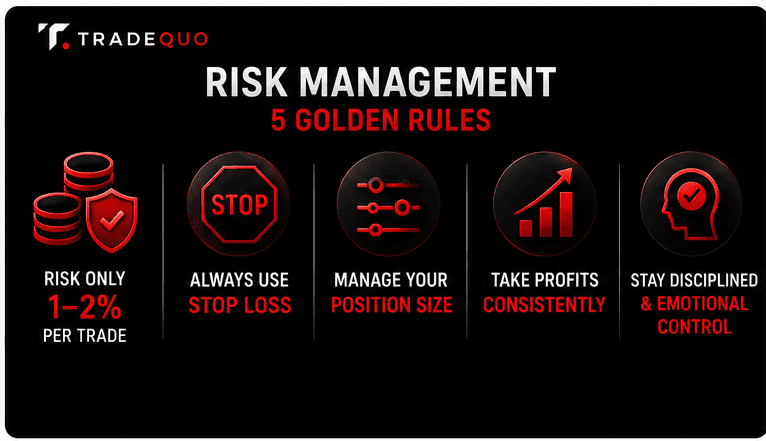
No discussion of day trading strategies is complete without a serious treatment of risk management. A trader can have an excellent strategy and still lose money if their risk controls are poor. In fact, most traders fail not because their strategy is flawed, but because they abandon their rules when under pressure.
Professional traders use several key controls:
Stop-Loss Orders: A stop-loss order is designed to limit losses by automatically exiting a trade at a predetermined price.
Position Sizing: Successful day traders rarely risk a large percentage of their trading account on a single trade. Instead, they allocate small portions of capital to each position to avoid major losses.
Daily Loss Limits: Setting a maximum loss per day is a smart way to prevent emotional decision-making. If you hit your limit, you close the trading platform and walk away.
Capital Requirements: Under the Financial Industry Regulatory Authority (FINRA) rules, a pattern day trader must maintain a minimum balance of $25,000.
Beyond the mechanics, risk management is also psychological. Emotional and psychological biases affect day traders constantly, particularly when a trade is moving against them. The urge to hold a losing trade longer than planned, hoping the market will turn, is one of the most destructive habits in trading. Building risk management rules into a written trading plan and following them regardless of how a trade feels in the moment is what separates successful traders from those who lose money over time.
Testing strategies before risking real money is strongly recommended. Many trading platforms offer demo accounts where new traders can practice without risking capital. Backtesting strategies on historical data can also help determine whether a system produces more wins than losses.
Ultimately, successful trading depends not only on identifying opportunities but also on protecting capital.
Conclusion

Day trading is not a get-rich-quick scheme. It is a skill, and like any skill, it requires study, practice, and emotional control. The strategies we’ve discussed - momentum, breakout, scalping, and mean-reversion - are the tools of the trade. But a tool is only as good as the craftsman using it. A hammer can build a house or smash a finger.
The key is to find a trading style that fits your schedule and your psychological makeup. If you hate sitting in front of a screen, scalping will be torture. If you need immediate feedback, swing trading might feel too slow. Once you find a style that resonates, you must build a trading plan around it and, most importantly, test it.
Before you risk a single dollar of real capital, open a demo account. Most reputable brokers offer them. Practice executing these strategies in a simulated environment. Track your trades. See if you actually would have made money. This is where you build the muscle memory of discipline without the financial pain of mistakes. The market will always be there. Make sure you are ready for it.
FAQs
What is the best day trading strategy for beginners?
There is no universally best strategy, but beginners often find breakout trading easier to understand because the rules are clearly defined. You wait for a price level to break with volume confirmation and enter with a pre-set stop-loss. Practicing any strategy on a demo account before trading live is strongly recommended, regardless of which approach you choose.
How much capital do I need to start day trading?
In the United States, the Financial Industry Regulatory Authority requires pattern day traders to maintain a minimum balance of $25,000 in a margin account. Outside of that regulatory threshold, the general guidance is to start with capital you can afford to lose entirely, since day trading involves significant risk and many new traders experience losses before becoming consistently profitable.
Can day trading strategies be used in any market?
Yes, the core strategies described here apply across stock markets, forex, futures, and other financial instruments. However, each market has its own characteristics in terms of volatility, trading hours, and liquidity. A strategy that works well in highly liquid large-cap stocks may need adjustment when applied to currency pairs or commodity futures. Always test your approach in the specific market you intend to trade.
How important is technical analysis in day trading?
Technical analysis is central to most day trading strategies. Indicators like moving averages, RSI, MACD, and Bollinger Bands help traders identify potential entry and exit points based on price history and volume. While no indicator predicts the future with certainty, technical analysis provides a structured, repeatable framework for making trading decisions rather than relying on instinct or emotion.
Is day trading suitable for everyone?
Day trading is a high-risk endeavor best suited to experienced investors with the time, capital, and temperament to handle fast-paced decision-making. Many retail traders lose money in the markets over time, and day trading amplifies both the potential gains and the potential losses compared to longer-term investing. Anyone considering day trading should research thoroughly, understand the risks, practice with a demo account, and only risk capital they can afford to lose.